The Honest Truth About Making Money Blogging
Let me tell you what most blogging advice leaves out.
It leaves out the six months of writing into the void before anyone reads your work. It leaves out the posts you spent eight hours on that got eleven views — three of which were you, checking if it had loaded correctly. It leaves out the moment you Google your own blog and find it sitting on page seven of the search results, beneath articles from 2014 written by websites that no longer exist.
It leaves all of that out. And then it tells you that blogging is a great way to make passive income.
It is. But the word “passive” is doing a lot of heavy lifting in that sentence. Before anything becomes passive, it is first extremely active. And most people who fail at blogging fail not because blogging doesn’t work — but because nobody told them what the active phase actually looks like.
This post is the thing I wish I had read before I started. The real version. No thumbnails, no promises, no income screenshots taken three years after the hard part was over.
The Honest Timeline
First, let’s talk about time — because this is where expectations go to die.
The average blog takes six to twelve months before it starts generating consistent income. Not weeks. Months. And that’s with regular posting, proper SEO, and active promotion. Without those things, the timeline stretches even further.
Here’s roughly what the journey looks like for most bloggers:
Months 1–2: You write posts. Almost nobody reads them. Your traffic comes from you, your mum, and one friend who clicked the link out of pity.
Months 3–4: Google starts to notice you exist. A few posts begin to rank for low-competition keywords. You get your first trickle of organic traffic — maybe 50–100 visitors a month. It feels small, but this is actually significant progress.
Months 5–6: If you’ve been consistent, traffic starts compounding. Posts that ranked on page three start climbing. You might hit 500–1,000 monthly visitors. Your first affiliate commission appears. It is probably ₹200. You screenshot it anyway.
Months 7–12: Real traction. Posts start ranking on page one. Traffic grows faster because older posts compound with newer ones. Income starts to feel less like a rounding error and more like a real number.
Month 12+: If you’ve stayed consistent, you have a real asset. A blog with 50+ posts, consistent traffic, and multiple income streams is worth real money — both in monthly revenue and as a sellable business.
This timeline assumes you do the work. Consistently. Even when nobody is reading. That’s the hard part that nobody posts about.
How Blogs Actually Make Money
Most people think blogs make money from ads. A few do — but ad revenue requires enormous traffic (we’re talking hundreds of thousands of monthly visitors) to be meaningful. For most blogs, especially in their first two years, ads are a rounding error.
The money comes from four other places:
1. Affiliate Marketing You recommend products and tools you genuinely use. When a reader clicks your link and buys, you earn a commission. This is the most accessible income stream for new bloggers — you don’t need a huge audience, just a trusting one. Even my newsletter with 47 subscribers generated ₹1,500 in affiliate income in one month. Quality of audience matters more than size.
The key word is “genuinely.” Recommending products you don’t use because they have a good commission rate is a fast way to lose your audience’s trust and a slow way to earn money. Only recommend what you’d tell a friend to buy.
2. Digital Products Templates, ebooks, mini-courses, guides, checklists. You create them once and sell them indefinitely. This is the income stream with the best ratio of effort to reward over time — but it requires an audience that trusts you enough to pay for something you’ve made.
Start with something small and genuinely useful. A template. A checklist. A resource guide. Price it accessibly — ₹199 to ₹499 — and let it build trust before you try to sell anything larger.
3. Services Your blog becomes your portfolio. Readers who like your writing hire you for freelance work. Readers who trust your financial thinking hire you for consulting. This is the fastest path to income from a blog — because it doesn’t require traffic volume, just quality. One reader who hires you for a ₹10,000 copywriting project is worth more than 10,000 readers who just scroll and leave.
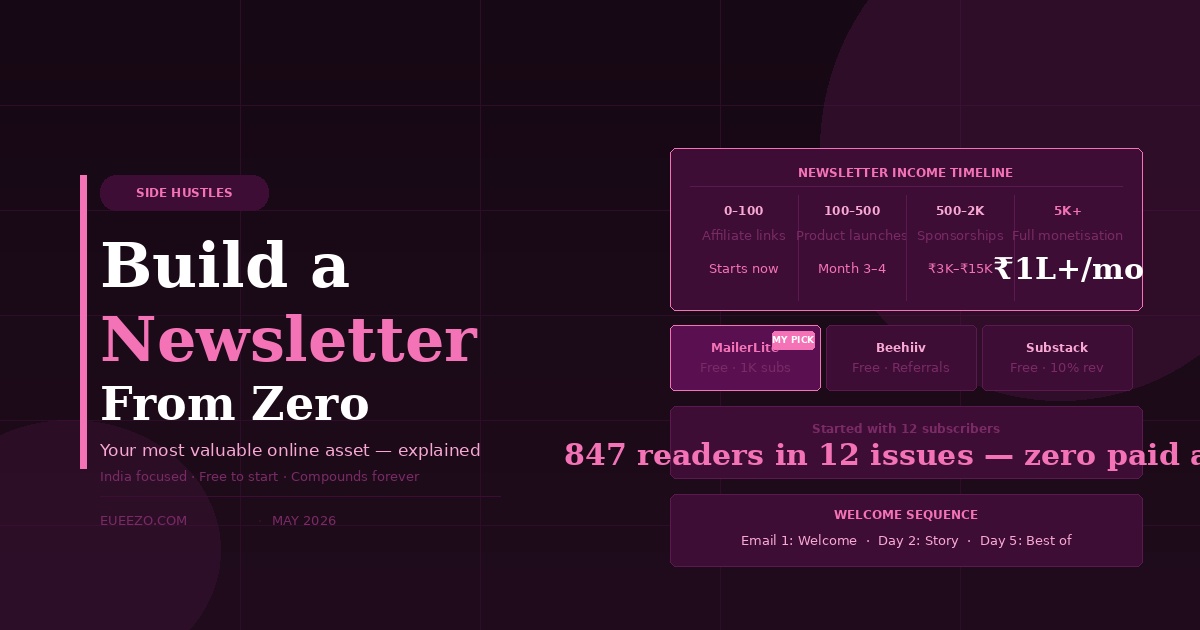
4. Newsletter Sponsorships Once your newsletter reaches a few thousand subscribers, brands will pay to be featured. In India, rates vary widely, but a newsletter with 5,000 engaged subscribers in a specific niche can charge ₹5,000–₹20,000 per sponsored mention. This income stream takes time to build — but it compounds beautifully with everything else.
The Three Things That Actually Determine Success
I’ve read enough blogging advice to know that most of it focuses on tactics — keyword research, post length, internal linking. These things matter. But they’re not what separates blogs that make money from blogs that don’t.
What actually determines success is three things:
Consistency over brilliance. The bloggers who win are rarely the best writers. They are the most consistent ones. A blog with 100 average posts will almost always outperform a blog with 10 brilliant ones — because volume gives Google more to index, gives readers more to find, and gives the writer more practice. Write regularly, even when you don’t feel like it. Especially when you don’t feel like it.
Specificity over breadth. “A blog about making money” competes with millions of sites. “A blog about making money online for Indians with no prior experience” competes with dozens. The more specific your focus, the easier it is to rank, the easier it is to build a loyal audience, and the easier it is to sell products that solve a precise problem. Eueezo exists because there was a gap — honest, specific, India-focused income reporting. That gap is the blog’s entire business model.
Trust over traffic. A small, trusting audience is worth more than a large, indifferent one. Every post you write is either building or eroding trust. Honest posts build it. Vague, hedging, “it depends” posts erode it. Recommending products you don’t believe in destroys it. Guard your readers’ trust like it is your most valuable asset — because it is.
What Nobody Tells You About the Middle
The beginning of a blog is exciting. The end — when things are working — is rewarding. The middle is neither.
The middle is writing your fourteenth post knowing that posts one through thirteen have been read by a combined total of maybe three hundred people. It is checking Google Search Console and seeing that your average position is 34 — meaning you’re buried on page four. It is watching a post you spent ten hours on get zero engagement while a throwaway three-paragraph post from two months ago quietly climbs to position eight for a keyword you didn’t even target.
The middle is where most blogs die. Not with a dramatic decision to quit, but with a gradual slowing down. Posts get less frequent. Weeks pass between updates. The blog sits there, half-built, a monument to good intentions.
The only way through the middle is to stop treating your blog as a vehicle for results and start treating it as a practice. Write because writing makes you better. Write because you have something to say. Write because the person who sits down to write post fifty is a fundamentally different — and better — writer than the person who wrote post one.
The results will come. They come for everyone who stays. But they rarely come before you’ve stopped needing them to.
The Practical Starting Point
If you’re reading this and thinking about starting a blog, here is the most useful advice I can give you:
Write for one person. Not for “your audience.” Not for the algorithm. For one specific person — the person you were twelve months ago, before you figured some things out. That person has real questions. Answer them honestly. That’s a blog.
Publish before you’re ready. Your first posts will not be good. This is not a problem — it’s a prerequisite. The only way to write good posts is to first write bad ones. Publish them anyway. Done is infinitely better than perfect-but-still-in-your-drafts.
Pick one distribution channel and go deep. Don’t try to be on Instagram, LinkedIn, Twitter, Pinterest, and YouTube simultaneously. Pick the one channel where your readers already spend time and show up there consistently. For a personal finance blog in India, LinkedIn and relevant Facebook groups are where I’d start.
Track the right early metrics. In Month 1 and 2, ignore traffic. Track posts published, keywords targeted, and links built. These are the inputs that will eventually produce the outputs.
Build the newsletter from Day 1. I said this in a previous post and I’ll say it again: your email list is the only audience you truly own. Social platforms change their algorithms. Google updates its rankings. Your email list stays yours. Start it before you feel ready to start it.
The Honest Bottom Line
Blogging works. It is one of the most reliable ways I know to build a genuine asset that generates income over time. But it works slowly, it works quietly, and it works only for people willing to stay in the game long enough for the compounding to kick in.
The honest truth about making money blogging is this: the money is real, but it’s on the other side of a long stretch of unrewarded work. Most people aren’t willing to do the unrewarded part. That’s not a criticism — it’s just the reality. And it’s also the opportunity.
If you’re willing to show up consistently while everyone else quits, the audience that’s left — the readers who find you, trust you, and eventually pay you — will be yours.
Start today. Write honestly. Stay longer than feels reasonable.
That’s it. That’s the whole strategy.
Eueezo is a blog about making money online honestly — income reports, real numbers, and lessons learned the hard way. Subscribe below for monthly updates.