Why Some Countries Are Rich While Others Stay Poor
Introduction
Look at a map of the world.
Some countries enjoy:
- High incomes
- Modern infrastructure
- Advanced healthcare
- Strong education systems
- High living standards
Meanwhile, others struggle with:
- Poverty
- Unemployment
- Weak institutions
- Limited economic opportunities
- Political instability
The difference can be enormous.
A person born in one country may earn 20 or 30 times more than someone born in another, even if both work equally hard.
Why?
Why are some countries rich while others remain poor?
For centuries, economists, historians, politicians, and researchers have debated this question.
Many explanations have been proposed.
Some point to geography.
Others focus on education, natural resources, culture, institutions, or history.
The truth is that no single factor determines a nation’s prosperity.
Instead, wealth tends to emerge when multiple conditions work together.
Understanding why countries become rich helps explain global inequality, economic development, migration, innovation, and the future of the world economy.
Because national wealth isn’t just about money.
It’s about the systems that allow people to create value at scale.
The Biggest Myth About Wealth
Many people assume rich countries became wealthy simply because they possess more natural resources.
At first glance, this seems logical.
Resources create value.
Oil, minerals, fertile land, and energy can generate enormous income.
Yet reality tells a different story.
Some resource-rich countries remain poor.
Meanwhile, several wealthy nations possess relatively few natural resources.
Examples include:
- Japan
- Singapore
- South Korea
These countries achieved remarkable prosperity despite limited natural advantages.
Resources matter.
But they are not destiny.
The Power of Institutions
Many economists believe institutions are among the most important drivers of national wealth.
Institutions include:
- Legal systems
- Property rights
- Governments
- Courts
- Financial systems
Strong institutions create trust.
Trust encourages investment.
Investment creates businesses.
Businesses create jobs and innovation.
Imagine starting a company.
Would you invest millions if property could be taken away arbitrarily?
Probably not.
Stable institutions reduce uncertainty.
That stability encourages economic activity.
Why Property Rights Matter
One of the foundations of economic growth is ownership.
People are more likely to invest when they know they can keep the rewards of their efforts.
Property rights allow individuals and businesses to:
- Own land
- Build companies
- Invest capital
- Create wealth
Without reliable ownership, long-term investment becomes risky.
Economic growth often suffers as a result.
Education Creates Productivity
Education is one of the most powerful wealth-generating tools ever developed.
Skilled workers generally produce more value than unskilled workers.
Education improves:
- Problem solving
- Innovation
- Productivity
- Entrepreneurship
Countries that invest heavily in human capital often experience stronger long-term growth.
The modern economy increasingly rewards knowledge.
This makes education even more important than in previous generations.
Why Innovation Matters
Innovation allows societies to produce more with fewer resources.
Consider how technology transformed:
- Agriculture
- Manufacturing
- Communication
- Transportation
Innovation increases productivity.
Higher productivity often leads to:
- Higher incomes
- Better living standards
- Economic growth
Many wealthy countries became prosperous partly because they created environments where innovation could thrive.
Geography Still Matters
While geography isn’t everything, it still influences economic outcomes.
Factors include:
Access to Trade Routes
Countries near major shipping routes often benefit from trade opportunities.
Climate
Extreme climates can create development challenges.
Natural Disasters
Frequent disasters can slow economic progress.
Agricultural Potential
Productive farmland historically supported population growth and economic development.
Geography provides advantages and disadvantages.
But it doesn’t determine destiny.
The Resource Curse
Surprisingly, natural resources can sometimes create problems.
Economists call this the “resource curse.”
Resource-rich countries may become overly dependent on:
- Oil
- Gas
- Minerals
- Commodities
When prices fall, economies suffer.
Additionally, resource wealth can sometimes weaken incentives to diversify.
This helps explain why some resource-rich countries struggle despite abundant natural wealth.
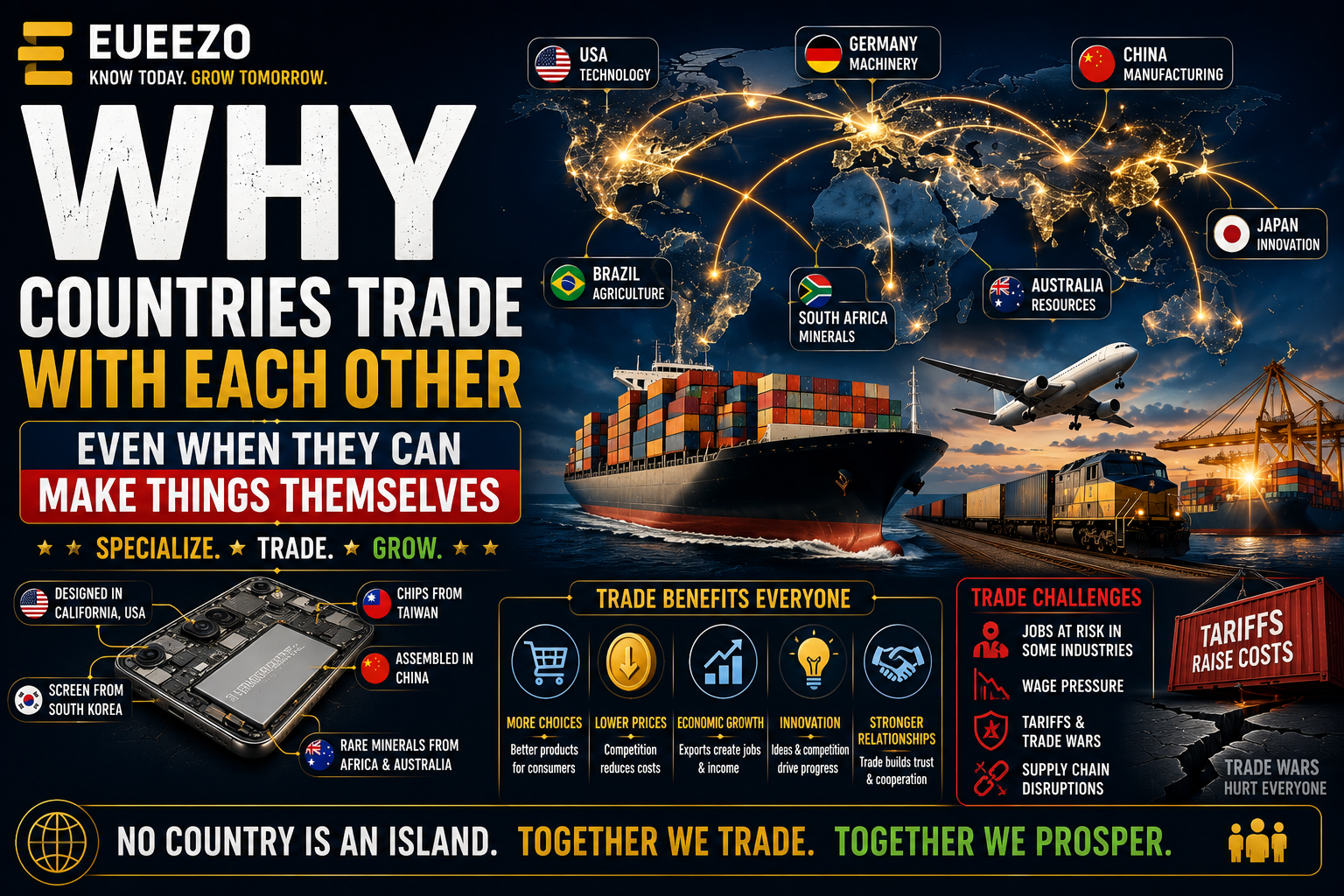
Trade and Economic Growth
Trade allows countries to specialize.
Instead of producing everything themselves, nations focus on areas where they are most efficient.
Benefits include:
- Lower costs
- Greater productivity
- More innovation
- Larger markets
Many wealthy countries achieved growth partly by integrating into global trade networks.
Isolation often limits economic opportunities.
Why Political Stability Matters
Businesses dislike uncertainty.
Investors dislike uncertainty.
Workers dislike uncertainty.
Political stability creates confidence.
Confidence encourages:
- Investment
- Hiring
- Entrepreneurship
- Long-term planning
Frequent instability can discourage economic activity.
This is one reason stable governance often correlates with prosperity.
Infrastructure Creates Opportunity
Economic activity depends on infrastructure.
Examples include:
- Roads
- Ports
- Airports
- Electricity
- Internet access
Infrastructure reduces costs and increases efficiency.
Without it, businesses struggle to operate effectively.
Many wealthy countries invested heavily in infrastructure over long periods.
The Importance of Financial Systems
Modern economies rely on capital.
Businesses need funding.
Entrepreneurs need loans.
Investors need markets.
Strong financial systems connect savings with productive opportunities.
This accelerates economic development.
Countries with weak financial systems often struggle to support large-scale growth.
Why Culture Can Influence Development
Culture is a sensitive topic.
No culture is inherently superior.
However, cultural attitudes can influence economic behavior.
Examples include attitudes toward:
- Education
- Entrepreneurship
- Risk-taking
- Long-term planning
- Innovation
These factors can affect how economies evolve over time.
The Role of History
History leaves long-lasting effects.
Colonialism.
Wars.
Political systems.
Economic policies.
Past events often shape present outcomes.
Some countries inherited strong institutions.
Others inherited instability.
Understanding economic development often requires understanding history.
Why Rich Countries Tend to Stay Rich
Wealth creates advantages.
Rich countries often possess:
- Better education
- Better infrastructure
- More capital
- Stronger institutions
- Advanced technology
These advantages reinforce one another.
Economists call this a positive feedback loop.
Success can create conditions that make future success more likely.
Can Poor Countries Become Rich?
Absolutely.
History provides many examples.
Countries such as:
- South Korea
- Singapore
- Ireland
transformed dramatically within a few decades.
Economic development is difficult.
But it is possible.
The right policies, institutions, investments, and opportunities can produce remarkable change.
The Future of Global Wealth
Technology is reshaping development.
Today, countries can participate in global markets through:
- Software
- Digital services
- Artificial intelligence
- Online education
- Remote work
This creates opportunities that didn’t exist previously.
The next generation of economic growth may look very different from the last.
What Wealth Really Means
National wealth is not simply about billionaires or stock markets.
It’s about creating environments where ordinary people can:
- Find opportunities
- Build businesses
- Access education
- Improve their lives
The richest countries generally create systems that allow large numbers of people to become productive.
That productivity ultimately drives prosperity.
The Bottom Line
Countries become rich for many reasons.
Strong institutions.
Education.
Innovation.
Trade.
Infrastructure.
Political stability.
History.
No single factor explains everything.
But one pattern appears consistently:
Prosperous nations tend to create systems that encourage productivity, investment, and opportunity.
Wealth isn’t simply discovered.
It’s built.
Over decades.
Sometimes centuries.
And while geography and history matter, the future remains open.
Countries can change.
Economies can grow.
Living standards can improve.
Because in the end, national wealth is not determined by luck alone.
It’s determined by the ability to create value, solve problems, and build systems that help people thrive.