Why Inflation Makes Everything More Expensive — And Why It Matters More Than You Think
Introduction
A few years ago, you could buy groceries for a certain amount of money.
Today, the same basket often costs significantly more.
Fuel prices rise.
Restaurant bills increase.
Rent climbs higher.
Travel becomes more expensive.
And suddenly, the money that once felt sufficient doesn’t go nearly as far.
This phenomenon has a name:
Inflation.
Inflation affects nearly every person, business, and government on Earth.
Yet despite hearing about it constantly in the news, many people don’t fully understand what it actually is.
Why do prices rise?
Who causes inflation?
Why don’t governments simply stop it?
And if inflation is bad, why do central banks often target some inflation instead of zero?
The answers reveal how modern economies function and why inflation remains one of the most important forces shaping your financial life.
Because inflation doesn’t just change prices.
It changes the value of money itself.
What Is Inflation?
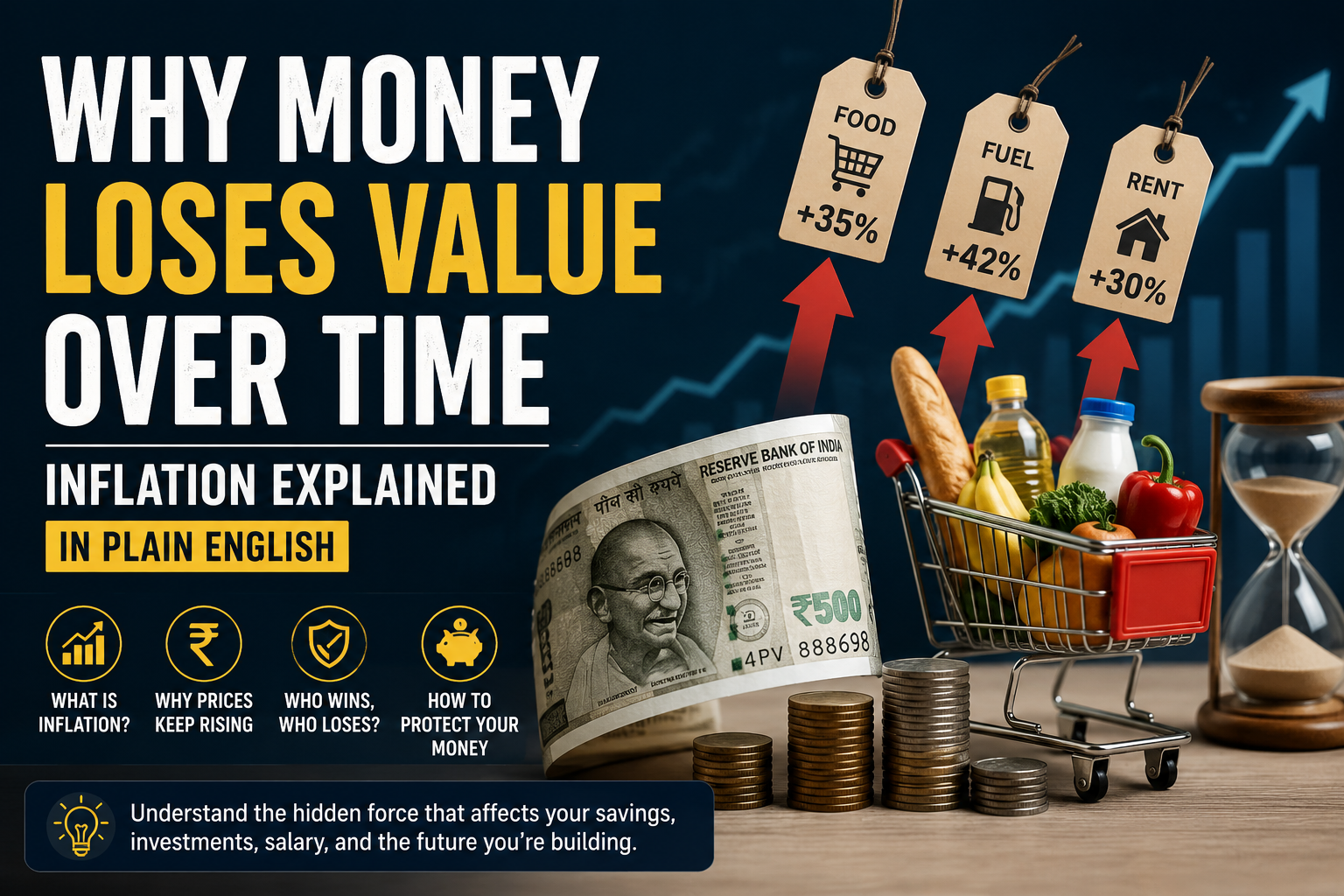
Inflation is the general increase in prices over time.
When inflation occurs:
- Food becomes more expensive
- Housing becomes more expensive
- Transportation becomes more expensive
- Services become more expensive
At the same time, the purchasing power of money falls.
This means each unit of currency buys fewer goods and services than before.
For example:
If a meal costs ₹200 today and ₹220 next year, inflation has occurred.
The money didn’t change.
The value of what that money can buy changed.
Why Inflation Matters
Many people underestimate inflation because price increases often happen gradually.
A coffee may cost a little more.
A grocery bill rises slightly.
A rent increase seems manageable.
But over years and decades, inflation compounds.
Small increases accumulate into major changes.
This is why older generations often tell stories like:
- “Movie tickets used to cost almost nothing.”
- “A house was much cheaper when I was young.”
- “Fuel prices were far lower years ago.”
The currency remained the same.
Its purchasing power changed.
The Simple Economics of Supply and Demand
One major cause of inflation is demand exceeding supply.
Imagine:
100 people want bicycles.
But only 50 bicycles are available.
Competition increases.
Prices rise.
The same principle applies throughout the economy.
When demand grows faster than production, inflationary pressure often emerges.
This is known as demand-pull inflation.
Too much demand.
Not enough supply.
When Businesses Face Higher Costs
Inflation can also occur when businesses face rising expenses.
Examples include:
- Higher wages
- Higher energy costs
- More expensive raw materials
- Transportation costs
Companies often pass some of these costs to consumers.
This creates cost-push inflation.
Prices rise because production becomes more expensive.
The Role of Money Supply
Money supply also matters.
Imagine an economy producing:
- The same number of goods
- The same number of services
But suddenly, much more money enters circulation.
More money now competes for the same products.
Prices may rise.
This is why economists often pay close attention to monetary policy and money creation.
However, money supply is only one piece of the puzzle.
Inflation is rarely caused by a single factor.
Why Governments Don’t Want Zero Inflation
This surprises many people.
Most central banks do not target zero inflation.
Instead, many aim for low, stable inflation.
Why?
Because modest inflation can support economic activity.
When people expect prices to rise slightly over time, they may be more likely to:
- Spend
- Invest
- Start businesses
Meanwhile, extremely low inflation or deflation can create different economic challenges.
The goal is balance.
Not too much.
Not too little.
What Is Deflation?
Deflation is the opposite of inflation.
Prices fall over time.
At first, this sounds wonderful.
Who wouldn’t want cheaper products?
But widespread deflation can create problems.
People may delay purchases because they expect prices to fall further.
Businesses earn less revenue.
Investment slows.
Economic activity can weaken.
This is why economists often view persistent deflation as a warning sign.
How Central Banks Fight Inflation
Central banks play a major role in controlling inflation.
One of their most important tools is interest rates.
When inflation rises too quickly:
Interest rates often increase.
Higher rates can:
- Reduce borrowing
- Slow spending
- Lower demand
This may help bring inflation under control.
The process isn’t immediate.
But it remains one of the primary tools used by modern economies.
Why Inflation Feels Different for Everyone
Official inflation numbers represent averages.
Individual experiences vary.
Consider two households.
Household A
Spends heavily on:
- Rent
- Food
- Fuel
Household B
Spends heavily on:
- Technology
- Entertainment
If food and fuel prices rise rapidly, Household A may feel inflation much more strongly.
This is why personal experiences often differ from official statistics.
The Hidden Tax on Savings
Inflation affects savers in important ways.
Imagine:
You save ₹1,00,000.
Five years later, you still have ₹1,00,000.
On paper, nothing changed.
But if prices increased significantly during those years, purchasing power declined.
The money buys less.
This is why many investors seek assets that can grow faster than inflation.
Who Benefits From Inflation?
Inflation is often presented as entirely negative.
Reality is more nuanced.
Some groups may benefit under certain conditions.
For example:
Borrowers
Debt becomes easier to repay if income rises while loan balances remain fixed.
Asset Owners
Real estate, stocks, and businesses sometimes increase in value during inflationary periods.
Governments
Inflation can reduce the real value of existing debt.
The effects vary depending on circumstances.
Who Gets Hurt the Most?
Inflation often impacts:
Savers
Cash loses purchasing power.
Fixed-Income Earners
Income may not rise as quickly as prices.
Retirees
Living costs may increase faster than benefits or savings growth.
This is why controlling inflation remains a major policy objective.
Why Inflation Became a Global Topic
During the COVID-19 pandemic and its aftermath, inflation became one of the most discussed economic issues in the world.
Several factors contributed:
- Supply chain disruptions
- Increased demand
- Energy price fluctuations
- Government stimulus programs
The result was higher inflation across many countries.
People who had never thought much about inflation suddenly experienced it directly.
Inflation and Housing
Housing often plays a major role in inflation.
When:
- Rent rises
- Property prices increase
- Construction costs climb
overall living expenses rise as well.
Housing affordability has become one of the biggest economic challenges in many countries.
And inflation often contributes to that pressure.
Inflation and Your Salary
One of the most misunderstood aspects of inflation is its impact on income.
A salary increase doesn’t automatically mean you’re better off.
If:
Salary rises 5%
But prices rise 7%
Your purchasing power actually declines.
This is why economists focus on real income, not just nominal income.
What matters isn’t how much money you earn.
What matters is what that money can buy.
How People Protect Themselves From Inflation
While nobody can eliminate inflation completely, people often use several strategies:
Investing
Assets may grow faster than inflation over long periods.
Skill Development
Higher-value skills can increase earning potential.
Diversification
Different investments respond differently to inflation.
Long-Term Planning
Financial planning helps reduce inflation’s impact over time.
The goal isn’t predicting inflation perfectly.
The goal is preparing for it.
The Future of Inflation
Inflation is unlikely to disappear.
Every modern economy experiences it to some degree.
The challenge is maintaining stability.
Too much inflation creates uncertainty.
Too little can weaken economic activity.
Central banks, governments, businesses, and consumers constantly adapt to changing economic conditions.
Managing inflation remains one of the most important balancing acts in economics.
The Bottom Line
Inflation is the gradual increase in prices over time and the corresponding decline in the purchasing power of money.
It affects everything:
- Salaries
- Savings
- Investments
- Housing
- Food
- Daily life
While moderate inflation is a normal part of modern economies, excessive inflation can create serious challenges.
Understanding inflation helps explain why prices change, why interest rates move, and why economic policy often dominates financial headlines.
Because in the end, inflation isn’t just about rising prices.
It’s about the changing value of money itself.
And that makes it one of the most important economic forces you’ll ever encounter.