The Compound Interest Effect: Why Starting at 25 Beats Earning More at 35
There is a story told in almost every personal finance book ever written.
Two people. Same income. Same investment returns. One starts investing at 25 and stops at 35 — ten years of contributions, then nothing. The other starts at 35 and invests every year until 65 — thirty years of contributions.
At 65, who has more money?
The person who stopped at 35.
By a significant margin.
This result feels wrong. It feels like a trick. Thirty years of investing should beat ten years of investing. More money in should mean more money out. But that is not how compound interest works — and understanding why is one of the most financially valuable things you will ever learn.
What Compound Interest Actually Is
Interest is money earned on money. If you deposit £1,000 in a savings account paying 5% annual interest, you earn £50 at the end of the year. Simple.
Compound interest is money earned on money that has already earned money.
In Year 2, you do not earn 5% on your original £1,000. You earn 5% on £1,050 — your principal plus the interest it already earned. That gives you £52.50 instead of £50. A difference of £2.50.
That sounds trivial. It is not — because this process repeats every year, and the amounts involved grow larger with each cycle.
By Year 10, you are earning 5% on £1,629. By Year 20, on £2,653. By Year 30, on £4,322. By Year 40, on £7,040.
The same 5% rate. Dramatically different amounts. Because the base keeps growing.
This is what Albert Einstein — apocryphally, since he probably never said this — is quoted as calling “the eighth wonder of the world.” Whoever earns it, earns it. Whoever pays it, pays it.
The Story in Numbers
Let me run the two-investor comparison properly so you can see exactly what happens.
Investor A — The Early Starter:
- Starts investing at age 25
- Invests £200/month for 10 years (until age 35)
- Total contributed: £24,000
- Then stops contributing entirely — never invests another pound
- Leaves the money to grow at 7% annual returns until age 65
Investor B — The Late Starter:
- Does nothing until age 35
- Then invests £200/month for 30 years (until age 65)
- Total contributed: £72,000
- Same 7% annual returns
At age 65:
| Investor A | Investor B | |
|---|---|---|
| Total contributed | £24,000 | £72,000 |
| Final value at 65 | £263,074 | £227,092 |
Investor A contributed £48,000 less. Invested for one-third the time. And ended up with £36,000 more.
The difference is time. The decade between 25 and 35 — the years when the invested money had the longest runway to compound — proved more valuable than three decades of contributions starting later.
Why Time Matters More Than Amount
The mathematics behind this result comes from the compound interest formula:
A = P(1 + r)^t
Where A is the final amount, P is the principal, r is the interest rate, and t is time.
Notice that time (t) is an exponent. Doubling your principal doubles your result. But doubling your time does not double your result — it squares your multiplier. The relationship between time and outcome is exponential, not linear.
This is why a 25-year-old who invests £100/month is doing something that a 45-year-old investing £300/month cannot replicate — despite putting in three times as much per month.
Let’s see this concretely:
£100/month from age 25 to 65 at 7%: Final value — approximately £262,000
£300/month from age 45 to 65 at 7%: Final value — approximately £197,000
Three times the monthly investment. Twenty years fewer. One hundred thousand pounds less at retirement.
Time is the only input to compound interest that cannot be bought.
The Rule of 72: The Mental Shortcut Every Investor Needs
There is a simple tool for estimating how long it takes for an investment to double: the Rule of 72.
Divide 72 by your annual interest rate and you get the approximate number of years it takes your money to double.
At 6% annual returns: 72 ÷ 6 = 12 years to double At 8% annual returns: 72 ÷ 8 = 9 years to double At 10% annual returns: 72 ÷ 10 = 7.2 years to double
Now apply this to the early vs late investor:
Investor A starts at 25. Their money has 40 years to grow at 7% (Rule of 72: doubles every ~10 years). So their initial investments double approximately four times:
- £1 at 25 → £2 at 35 → £4 at 45 → £8 at 55 → £16 at 65
Investor B starts at 35. Their money has 30 years to grow:
- £1 at 35 → £2 at 45 → £4 at 55 → £8 at 65
The early investor’s money doubles four times. The late investor’s money doubles three times. That extra doubling — the difference between 8x and 16x growth — is the entire story of why starting early matters so much.
The Other Side of Compound Interest: Debt
Everything above applies equally to debt — but in reverse.
If compound interest is the most powerful force for building wealth, it is also the most powerful force for destroying it.
A credit card balance of £3,000 at 20% APR compounds against you every month you carry it. In year one, you owe £600 in interest. In year two — if you have not paid it down — you owe interest on a balance that has grown. Left unpaid for five years, a £3,000 debt at 20% becomes nearly £7,500.
The same exponential mathematics that builds wealth through investing destroys it through high-interest debt. This is why eliminating credit card debt before investing is not just emotionally satisfying — it is mathematically correct. Paying off a 20% debt is a guaranteed 20% return. No investment reliably matches that.
The order of priority that compound interest logic suggests:
- Pay off high-interest debt (anything above 7-8% — this beats expected investment returns)
- Build an emergency fund (3-6 months of expenses, liquid)
- Capture any employer pension match (instant 50-100% return)
- Invest for the long term in low-cost index funds
Only at step four does compound interest start working for you through investment returns. Steps one through three are about eliminating the ways it works against you.
What Rate of Return Should You Assume?
The compound interest calculations above use 7% as the assumed annual return. Where does this number come from?
The historical average annual return of the global stock market — specifically, indices like the S&P 500 — has been approximately 10% in nominal terms and 7% in inflation-adjusted (real) terms over the past century.
This is not a guarantee. Markets have decades of poor returns — Japan’s stock market in the 1990s, US markets in the 2000s, various emerging markets at various points. Past returns do not guarantee future performance.
But 7% is a reasonable planning assumption for a globally diversified long-term equity investor — the kind of assumption financial planners commonly use for projections.
A few important caveats:
Fees matter enormously. If you invest in actively managed funds with 1.5% annual fees, your effective return drops from 7% to 5.5%. At 5.5% with the Rule of 72, your money doubles every 13 years instead of every 10. Over 40 years, the difference between 7% and 5.5% costs you nearly half your final portfolio value. This is why low-cost index funds — with fees typically below 0.2% — are so widely recommended.
Tax efficiency matters. Returns inside a tax-advantaged account (ISA in the UK, Roth IRA in the US, superannuation in Australia) compound without being reduced by annual tax on gains or dividends. Returns in a taxable account lose a portion to tax each year, reducing the effective compounding rate.
Volatility is real. The 7% average includes years where markets fell 30%, 40%, or more. Investors who panic and sell during downturns lock in losses and miss the recoveries. The return is only accessible to investors who stay invested through the difficult periods.
The Impact of Inflation: The Silent Compounding Force
Compound interest works in one more direction that most people underestimate: inflation.
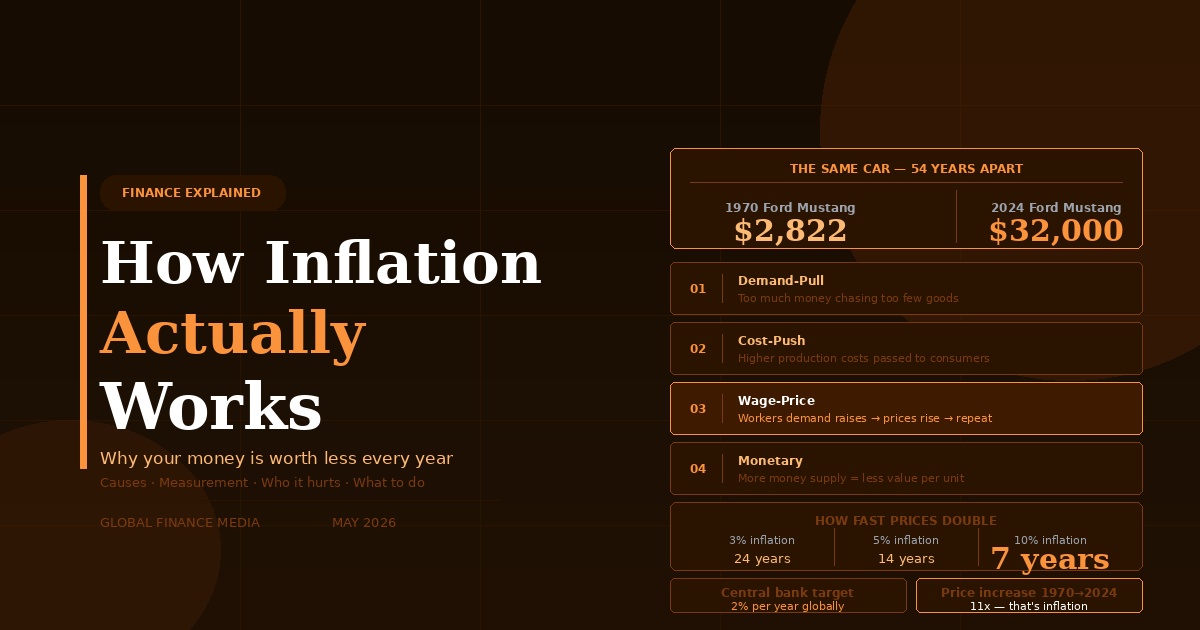
Inflation is the compounding erosion of your money’s purchasing power. At 3% annual inflation, prices double roughly every 24 years (Rule of 72: 72 ÷ 3 = 24).
Money sitting in a savings account earning 1% while inflation runs at 3% is losing purchasing power at 2% per year — compounding. Over 20 years, that apparently “safe” cash loses more than 30% of its real value.
This is why holding large amounts of cash is not actually safe. It is a slow, invisible erosion of wealth. The only genuine hedge against inflation’s compounding effect is investment returns that exceed it — which, historically, equity markets have provided over long time horizons.
The three compounding forces acting on your finances simultaneously:
- Compound interest on investments — working for you
- Compound interest on debt — working against you
- Compound inflation on cash savings — working against you quietly
Winning financially is not about being clever. It is about maximising the force working for you and minimising the forces working against you.
Practical Steps: Starting Today at Any Age
If you are 25: The numbers above are working maximally in your favour. Even £50 per month invested now is worth more than £150 per month invested at 40. Start anything — the amount matters far less than the habit and the time.
If you are 35: You have missed the most powerful compounding years but not the important ones. Thirty years of compounding still produces meaningful wealth. Increase your savings rate and invest in low-cost global index funds.
If you are 45: The runway is shorter but not negligible. Twenty years of compounding at 7% still produces 3.87x growth on every pound invested today. The priority at this stage is maximising your savings rate and eliminating any remaining high-interest debt.
If you are 55: Ten years of compounding doubles your money at 7%. Less dramatic than the earlier decades but still meaningful. The focus shifts partly toward capital preservation alongside growth, and toward ensuring tax-efficient withdrawal strategies.
Whatever your age: the second-best time to start is today. The best time was ten years ago — and that time is gone. Today is what you have.
The One Paragraph That Summarises It All
Compound interest is simple and brutal in equal measure. It rewards patience and punishes delay. It makes the first decade of investing worth more than the last three decades. It turns high-interest debt into a financial emergency. It makes inflation a silent thief of cash savings. And it makes a 0.2% fund fee and a 1.5% fund fee — which sound almost identical — worth hundreds of thousands of pounds different over a working lifetime.
Understanding this does not require a finance degree. It requires grasping one principle: exponential growth is counterintuitive, and the single most important input is time.
Start now. Invest regularly. Keep fees low. Do not touch it.
Everything else is a detail.
Eueezo explains business and finance in plain English — for real people making real financial decisions. Subscribe to our weekly briefing below.