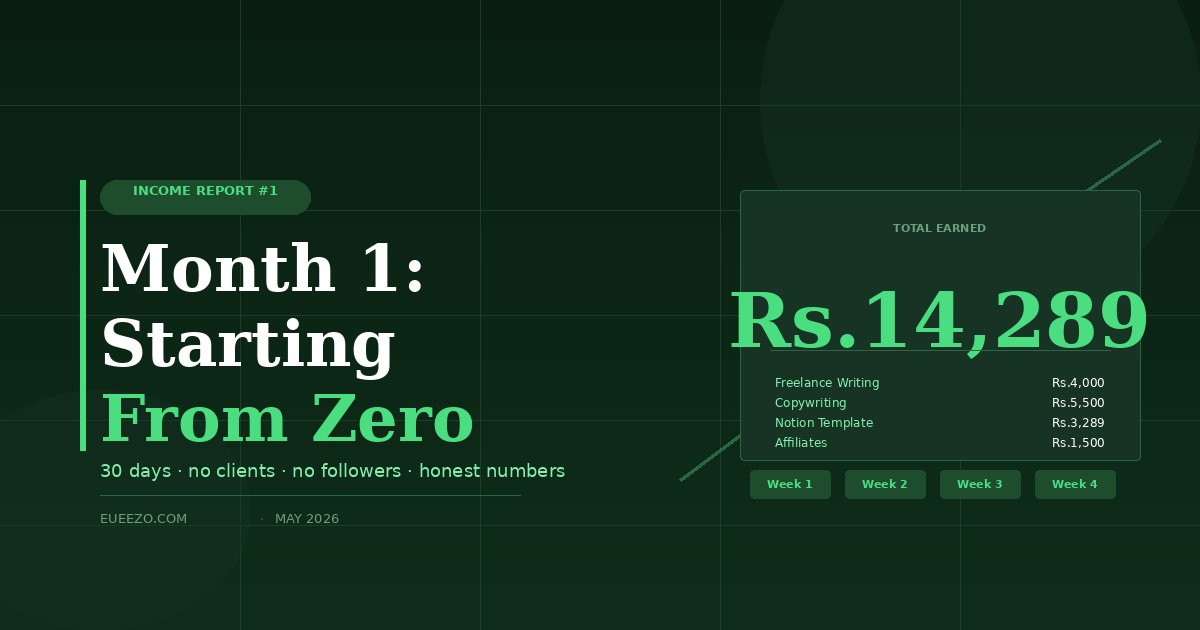
Month 3 Income Report: ₹35,200 — The Month Everything Started Feeling Real
At the start of Month 3, I set a goal of ₹35,000.
I hit ₹35,200.
I want to be careful about how I frame that. It would be easy to write a triumphant post about crushing my target, about the system working, about everything clicking into place. And some of that is true. But the honest version is more complicated — because Month 3 was also the month I made my biggest mistake so far, learned my most expensive lesson, and had a genuine crisis of confidence around Week 2 that nearly derailed everything.
The number is ₹35,200. The story behind it is what I actually want to tell you.
The Full Breakdown
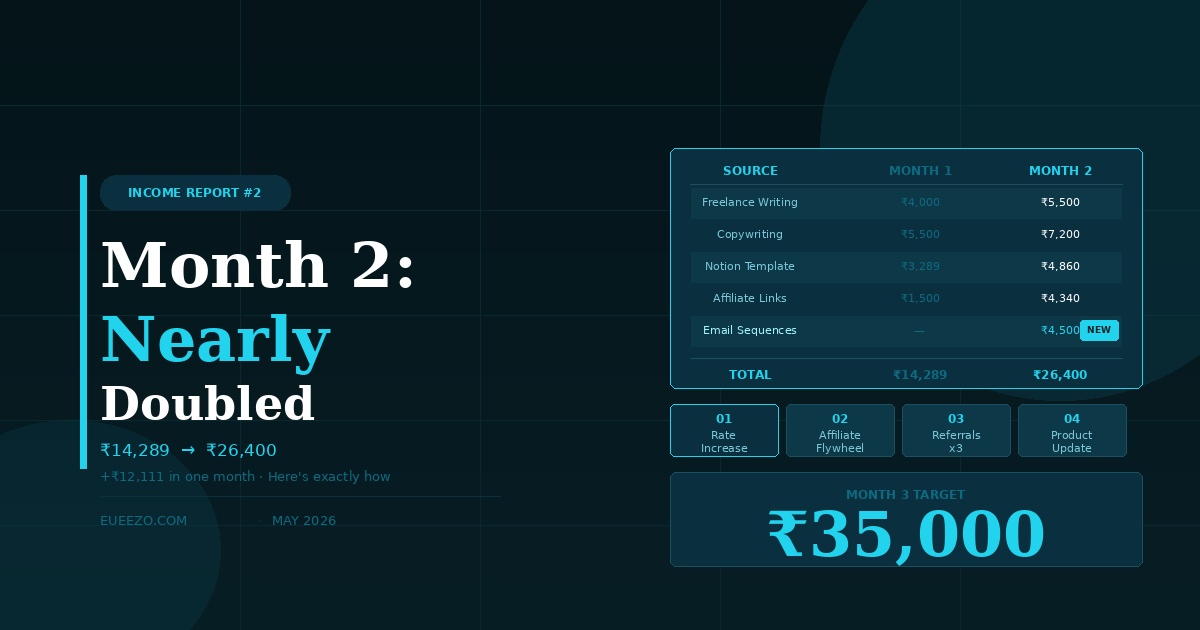
| Source | Month 2 | Month 3 | Change |
|---|---|---|---|
| Freelance Writing | ₹5,500 | ₹6,400 | +₹900 |
| Copywriting Projects | ₹7,200 | ₹8,500 | +₹1,300 |
| Notion Template Sales | ₹4,860 | ₹5,100 | +₹240 |
| Affiliate Commissions | ₹4,340 | ₹5,800 | +₹1,460 |
| Email Sequences | ₹4,500 | ₹3,900 | -₹600 |
| New: Pitch Template Pack | ₹0 | ₹5,500 | +₹5,500 |
| Total | ₹26,400 | ₹35,200 | +₹8,800 |
The headline number is ₹35,200. But the story is in the details.
Email sequences — my fastest-growing stream in Month 2 — actually declined. The client who had commissioned two sequences in Month 2 didn’t have new work in Month 3. That single dependency cost me ₹600 compared to last month, and reminded me of something I keep having to relearn: a single client is not an income stream. It’s a risk.
The new line — Pitch Template Pack — contributed ₹5,500 in its launch month. That was the new digital product I’d planned to release. It was also the source of Month 3’s biggest lesson, which I’ll get to shortly.
What Went Right
The Affiliate Flywheel Is Real
Affiliate commissions grew from ₹4,340 to ₹5,800 — a 34% increase — despite me spending almost no additional time on affiliate content.
What drove the growth: two blog posts from Month 1 started ranking on page two of Google for low-competition keywords. They were not driving enormous traffic — maybe thirty to forty additional visitors per week combined. But those visitors were highly targeted. People searching for “freelance income tracker India” or “best tools for freelancers India” are exactly the people who would buy a Notion template or sign up for an invoicing tool.
This is the compounding effect I had theorised about in Month 1 but not yet experienced. Older content starting to rank. Readers who found the blog organically converting at higher rates than readers who arrived from social media. Affiliate commissions arriving from links I had placed two months ago and mostly forgotten about.
Month 3 was the first month where I could genuinely feel the compounding. It is a very different feeling from grinding.
My Writing Rate Held After the Increase
In Month 2, I raised my writing rate from ₹500 to ₹800 per article. I was half-expecting pushback in Month 3 — clients reconsidering, requests to go back to the old rate, someone finding a cheaper writer.
None of that happened. The agency increased their order volume slightly. The referral clients I’d acquired in Month 2 accepted the new rate without question. One new client — who came through a LinkedIn comment I’d left on someone’s post — hired me directly at ₹1,000 per article without negotiation.
That last detail matters. A year ago, if someone had told me I would charge ₹1,000 per article and a client would accept it without negotiating, I would not have believed them. The rate increase that felt like a gamble in Month 2 now feels like I’m still undercharging.
LinkedIn Started Working
In Month 2, I had committed to posting on LinkedIn twice a week. In Month 3, that consistency started to produce results.
Three things happened:
A post about personalised pitching got 4,200 impressions. Several people commented that they had been pitching wrong and were changing their approach. Two of those commenters became newsletter subscribers. One became a client.
A founder I had been following on LinkedIn for months commented on one of my posts. We got into a conversation. He mentioned he needed email sequence help. I sent a proposal. He hired me for ₹3,500 worth of work — all from a comment thread.
My connection requests started being accepted at a higher rate. People recognised my name from the posts before they saw the request. That recognition is the beginning of what a personal brand actually does.
What Went Wrong: The Launch Mistake
In Month 3, I launched my second digital product — a Pitch Template Pack containing 20 freelance pitch templates for different industries and scenarios, priced at ₹399.
The launch generated ₹5,500 in its first month. That sounds like a win. It was not a clean win.
I built the product in four days — too fast. In my excitement to have a second product live, I cut corners on the quality of six of the twenty templates. They were functional but not exceptional. Three customers noticed. One left a public review on Gumroad that said: “Most templates are great but a few feel rushed. Would have liked more examples.”
That review sat on my product page for the rest of the month. I am certain it cost me sales. The conversion rate on the product page dropped noticeably after it appeared.
I spent an afternoon fixing the six templates immediately and updated the product. But the review stayed. And I learned something I will not forget: in the digital product space, the cost of launching something that is 80% ready is paid not just in the present but in every future sale that a mediocre review prevents.
Ship when it’s ready. Not when you are tired of working on it.
What I Did Differently
I started tracking where every client came from.
In Month 3, I created a simple log: every new client, how they found me, and the value of their first project.
- Referrals from existing clients: 3 clients, ₹11,200 in value
- LinkedIn content: 1 client, ₹3,500 in value
- Direct outreach: 2 clients, ₹4,800 in value
- Inbound from blog: 1 client, ₹2,400 in value
Referrals accounted for 52% of new client revenue. This data immediately changed my priorities. I stopped spending time on platforms that weren’t generating clients. I doubled down on delivering exceptional work for existing clients and asking directly for introductions.
I introduced a 50% upfront deposit for all projects above ₹2,000.
After the late payment experience in Month 2, I finally implemented deposits. Every new client over ₹2,000 received a deposit request before I began work. Zero clients refused.
I sent my first dedicated affiliate email.
Rather than including affiliate recommendations as footnotes in general newsletter issues, I sent one issue entirely focused on “the tools I use every month and why.” I disclosed affiliate relationships clearly at the top.
Open rate: 61%. Click-through rate: 22%. Affiliate conversions: 14.
That single email generated ₹2,800 in affiliate commissions — more than my entire affiliate income in Month 1, from a single send to a list of 189 subscribers.
The Week 2 Crisis
Around Day 12, the Gumroad review dropped. Three writing projects were in revision cycles simultaneously. A client who had seemed enthusiastic went quiet for five days. My newsletter open rate dipped from 58% to 41%.
None of these things were catastrophic individually. Together, in the same week, they felt like evidence that the momentum was ending.
I spent two days being unproductive. I opened my income tracker obsessively. I rewrote a pitch four times and sent none of the versions.
On Day 14, I went back and read Month 1’s income report. The one where I was earning ₹0 in Week 1 and celebrating ₹2,500 as a breakthrough.
The perspective shift was immediate and almost embarrassing. The “crisis” of Month 3 Week 2 was objectively better than the best week of Month 1. The dip in newsletter open rate was still double the industry average. The quiet client came back on Day 16 with a new project.
I wrote in my journal that night: progress is not a straight line. It is a general direction.
Goals for Month 4
Income target: ₹42,000
Specific actions:
- Fix the pitch template pack — add ten more templates and update the six weak ones
- Write two SEO posts targeting keywords with 500+ monthly searches
- Grow newsletter to 300 subscribers
- Source one new anchor client to replace the email sequence dependency
- Apply for one speaking slot or guest post opportunity to expand reach
For the Person Reading This in Month 0
Month 3 was ₹35,200. But it was built entirely on the foundation of Months 1 and 2 — the slow months, the uncertain months, the months where I did not know if any of this would work.
The foundation is the work. There is no shortcut to it. But it is available to anyone willing to do it.
Start. Document it. Stay longer than feels comfortable.
Month 4 report in four weeks.
Eueezo publishes monthly income reports and honest freelancing guides for Indians building an online income. Subscribe below.