
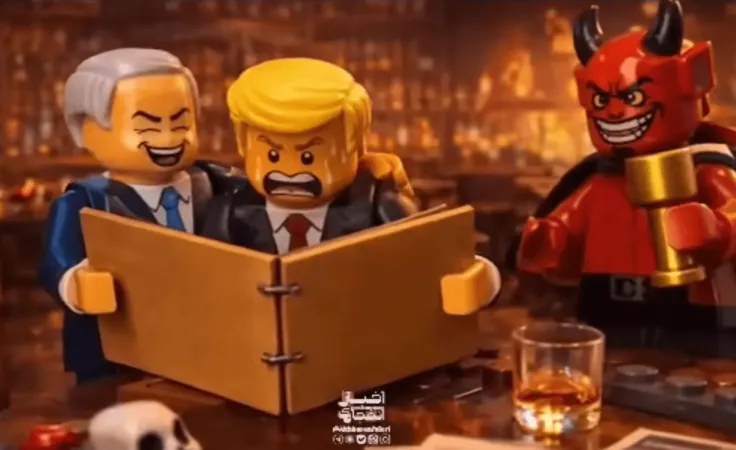
Iranian state media has released a controversial AI-generated video that uses Lego-style animation to show a fictional war scenario involving the United States and Israel. The video is widely seen as part of a growing digital propaganda battle during rising tensions in the Middle East. (www.ndtv.com)
What the Video Shows
The two-minute video uses toy-like characters that resemble Lego figures to portray global leaders and military attacks. In the animation, figures representing U.S. President Donald Trump and Israeli Prime Minister Benjamin Netanyahu appear alongside a devil character while looking at a folder labeled “Epstein file.” (www.ndtv.com)
After this scene, the Trump character presses a red button that launches a missile. The missile is shown hitting a school classroom, which the video suggests represents a deadly strike in the Iranian city of Minab. (www.ndtv.com)
The video then shifts to scenes of destruction, including rubble and children’s belongings. Afterward, Iranian forces are depicted retaliating with missile strikes against targets linked to the United States and its allies across the Middle East. (The Times)
A Message Without Dialogue
Interestingly, the animation contains no spoken dialogue. Analysts believe the creators intentionally made it this way so that it could be understood by audiences around the world without language barriers. (www.ndtv.com)
The video ends with a message honoring students allegedly killed in the attack, describing them as “martyrs.” The clip suggests that Iran’s response is a form of revenge against Western forces. (www.ndtv.com)
Part of a Wider Information War
Experts say the video is part of a broader digital information war. Governments and online networks are increasingly using AI-generated images and videos to influence public opinion during conflicts. (WIRED)
Such content often spreads quickly on social media platforms, making it difficult for viewers to distinguish between real events and staged or manipulated visuals.
Growing Concerns About AI Propaganda
The rise of AI tools has made it easier for governments and groups to create convincing propaganda videos. Experts warn that this trend could make misinformation more powerful during geopolitical conflicts. (The Guardian)
As technology improves, media organizations and fact-checkers say verifying digital content will become more important to prevent the spread of false narratives online.