How Visa And Mastercard Became Two Of The Most Powerful Companies You’ve Never Really Thought About
Introduction
Every day, billions of people buy coffee, groceries, airline tickets, smartphones, and online subscriptions using a debit or credit card.
The process feels almost instant.
You tap your card.
The payment is approved.
You walk away.
Most people never stop to think about what actually happened behind the scenes.
In just a few seconds, a global financial network verified your identity, checked your bank balance, communicated with the merchant, and transferred payment securely.
At the center of that process are two companies:
Visa and Mastercard.
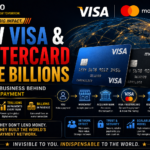
Together, they process trillions of dollars in payments every year and connect consumers, banks, merchants, and governments across more than 200 countries.
Yet unlike banks, they don’t lend money.
Unlike retailers, they don’t sell products.
And unlike most financial companies, they rarely carry significant credit risk.
Instead, Visa and Mastercard built one of the most profitable business models in history.
What Exactly Do Visa And Mastercard Do?
One of the biggest misconceptions is that Visa and Mastercard issue credit cards.
They don’t.
Instead, they operate payment networks.
Think of them as digital highways connecting:
- Consumers
- Banks
- Businesses
- Payment processors
Whenever someone pays with a Visa or Mastercard, the network helps authorize and complete the transaction within seconds.
Without these networks, modern electronic payments would be far more complicated.
Who Actually Lends The Money?
If Visa doesn’t lend money, who does?
Usually, it’s your bank.
For example:
- HDFC Bank
- ICICI Bank
- SBI
- Chase
- Bank of America
The bank issues the card.
The bank decides your credit limit.
The bank collects interest if you don’t pay your balance.
Visa and Mastercard simply facilitate the transaction and earn fees for using their networks.
How They Make Money
Visa and Mastercard don’t rely on loan interest.
Instead, they earn revenue through transaction-related fees.
Every time someone uses one of their cards, a small fee flows through the payment system.
Individually, these fees are tiny.
But consider the scale.
Billions of transactions occur every year.
Those small fees quickly become billions of dollars in revenue.
It’s a business model built on volume rather than individual transaction size.
The Network Effect
One of the biggest reasons Visa and Mastercard became so dominant is something economists call the network effect.
Here’s how it works:
The more merchants accept Visa and Mastercard…
The more consumers want their cards.
The more consumers carry those cards…
The more businesses feel compelled to accept them.
This cycle strengthens itself over time, making it difficult for new competitors to break into the market.
A Truly Global Business
Visa and Mastercard operate in more than 200 countries and territories.
Whether you’re buying lunch in India, booking a hotel in Europe, or shopping online from the United States, there’s a good chance one of these networks is processing the payment.
This global reach has helped both companies become essential parts of the modern financial system.
Why They Don’t Need To Own Banks
Unlike traditional banks, Visa and Mastercard don’t need to hold customer deposits.
They don’t operate thousands of branches.
They don’t manage large loan portfolios.
This allows them to maintain relatively asset-light business models while still generating enormous revenue.
Lower risk and high transaction volumes have made them some of the most profitable companies in the financial sector.
The Shift To Cashless Payments
One of the biggest trends supporting Visa and Mastercard is the global move away from cash.
Consumers increasingly prefer:
- Contactless payments
- Mobile wallets
- Online shopping
- Digital banking
Every time cash is replaced by electronic payments, companies like Visa and Mastercard have an opportunity to process more transactions.
That creates a powerful long-term growth opportunity.
Competition Is Increasing
Although Visa and Mastercard dominate global card payments, competition is growing.
New payment systems include:
- Apple Pay
- Google Pay
- UPI
- PayPal
- Buy Now, Pay Later services
However, many of these services still rely on Visa or Mastercard infrastructure behind the scenes.
Rather than replacing the networks, they often build on top of them.
Why Investors Love These Companies
Investors admire Visa and Mastercard for several reasons:
High Profit Margins
Processing digital payments is highly scalable.
Consistent Growth
Electronic payments continue expanding globally.
Strong Competitive Advantages
Their networks are extremely difficult to replicate.
Global Reach
They benefit from worldwide consumer spending.
Together, these qualities have helped make Visa and Mastercard two of the world’s most valuable financial companies.
The Future Of Digital Payments
The payments industry continues evolving.
Future growth areas include:
- Artificial intelligence
- Cross-border payments
- Embedded finance
- Digital wallets
- Blockchain technology
Visa and Mastercard are investing heavily in these areas to remain leaders as consumer behavior changes.
What Entrepreneurs Can Learn
The success of Visa and Mastercard offers several important business lessons.
Build Infrastructure
Sometimes the most valuable businesses don’t sell directly to consumers.
Scale Matters
Serving millions—or billions—of users creates powerful advantages.
Solve A Universal Problem
Every business needs payments.
Focus On Reliability
Trust is essential in financial services.
These principles have helped both companies maintain leadership for decades.
The Bottom Line
Visa and Mastercard built one of the strongest business models in modern history by becoming the invisible infrastructure behind global commerce.
Rather than lending money or selling products, they created trusted payment networks that connect consumers, banks, and businesses around the world.
As digital payments continue replacing cash, their importance is only likely to grow.
Most people rarely think about Visa or Mastercard when buying a cup of coffee.
But behind nearly every swipe, tap, or online purchase, these companies are quietly powering the global economy.
Tags: Visa, Mastercard, Fintech, Digital Payments, Business, Finance, Banking, Investing, Technology, Economy, Visa business model, Mastercard business model, digital payments, payment networks, Visa vs Mastercard, fintech, financial technology, cashless economy, payment processing, business explained