Why Nobody Can Predict the Future — And Why People Keep Trying Anyway
Introduction
Every day, millions of predictions are made around the world.
Investors predict stock markets.
Economists predict recessions.
Businesses predict consumer behavior.
Governments predict economic growth.
Sports fans predict winners.
Weather experts predict storms.
And ordinary people constantly predict what will happen next in their own lives.
Some predictions turn out to be remarkably accurate.
Many do not.
Yet despite centuries of mistakes, failed forecasts, and unexpected events, humans continue trying to predict the future.
Why?
Because uncertainty is uncomfortable.
The future represents one of the biggest mysteries humans face.
We want certainty.
We want control.
We want to know what’s coming next.
But reality has a habit of surprising us.
History is filled with events that almost nobody predicted:
- Major financial crashes
- Technological revolutions
- Global pandemics
- Political upheavals
- Business disruptions
- Scientific breakthroughs
Again and again, experts confidently forecast one future, only for reality to produce another.
So why is predicting the future so difficult?
And why do people continue trying anyway?
The answer reveals fascinating truths about psychology, economics, probability, and the limits of human knowledge.
Because understanding why prediction fails may be one of the most valuable forms of wisdom.
Humans Are Prediction Machines
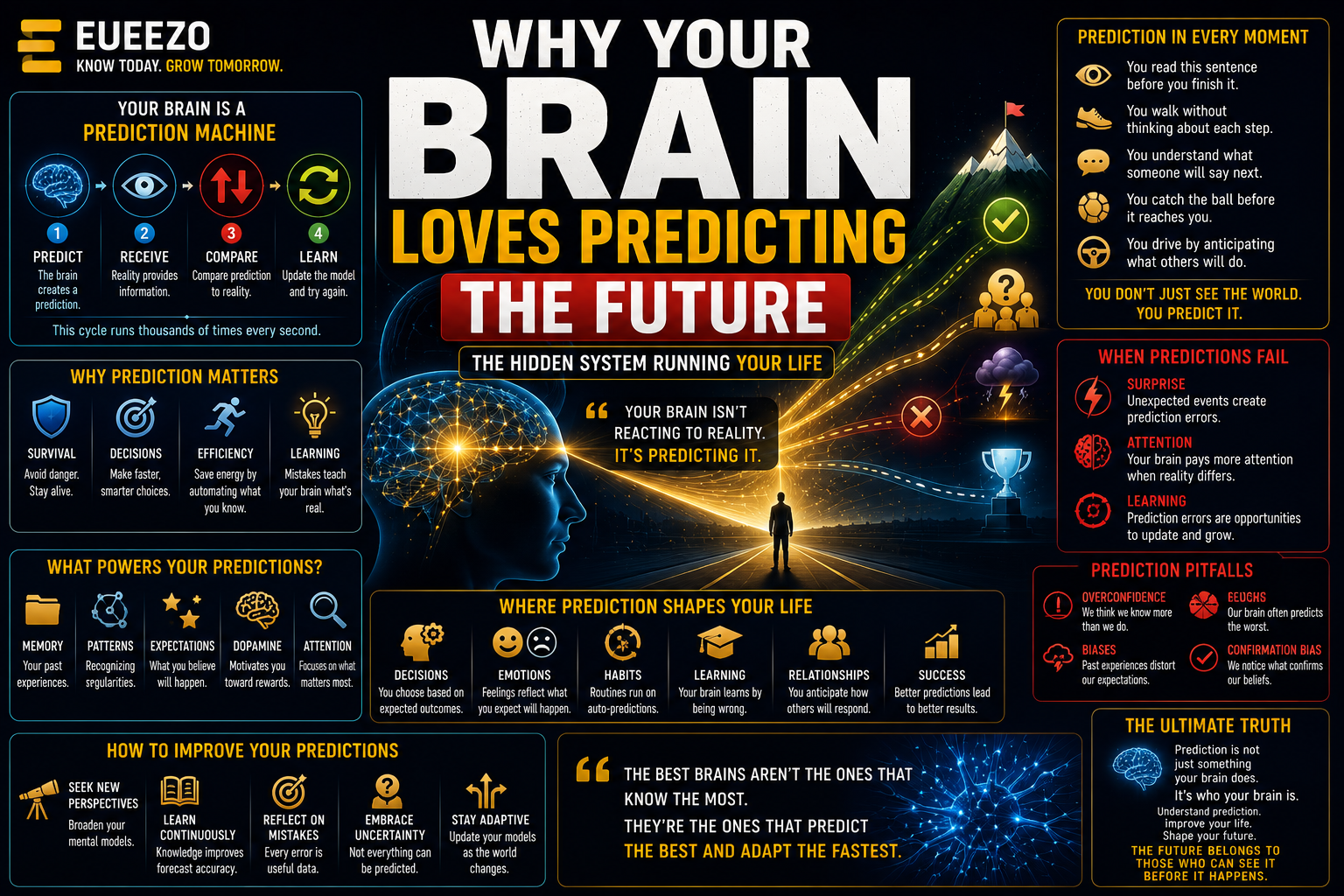
The human brain evolved to anticipate the future.
For survival, our ancestors needed to predict:
- Weather patterns
- Animal behavior
- Food availability
- Potential dangers
Those who predicted better often survived longer.
Prediction became deeply embedded in human psychology.
The problem is that modern life is far more complex than the environments our brains evolved for.
The future isn’t just uncertain.
It’s incredibly complicated.
The Complexity Problem
Imagine predicting a coin flip.
There are only two outcomes.
Simple.
Now imagine predicting:
- The global economy
- Stock markets
- Technology trends
- Human behavior
Suddenly thousands—or millions—of variables matter.
Small changes can create enormous consequences.
Complex systems are difficult to forecast because everything influences everything else.
The Butterfly Effect
One of the most famous ideas in science is the butterfly effect.
The concept suggests that tiny changes can eventually produce massive outcomes.
A small event today may trigger enormous consequences later.
This makes long-term prediction extraordinarily difficult.
Because even tiny unknown factors can alter the future dramatically.
Why Experts Get Things Wrong
Many people assume experts can predict the future accurately.
Experts often know more than average people.
But knowledge is not the same as certainty.
Even highly educated professionals struggle with forecasting.
Why?
Because expertise improves understanding.
It doesn’t eliminate uncertainty.
The future remains unpredictable regardless of intelligence.
The Problem With Forecasts
Forecasts often create an illusion of precision.
You’ll hear predictions such as:
- GDP growth: 3.2%
- Inflation: 4.1%
- Market returns: 8%
These numbers appear exact.
Reality rarely is.
Forecasts often communicate confidence that doesn’t actually exist.
The future is usually a range of possibilities rather than a single outcome.
Why People Love Predictions
Humans dislike uncertainty.
Uncertainty creates anxiety.
Predictions reduce that anxiety.
Even inaccurate predictions can feel comforting.
Why?
Because having a story about the future feels better than admitting we don’t know.
This psychological need helps explain why predictions remain popular.
The Media Incentive
Predictions attract attention.
Headlines such as:
- “Market Crash Coming Soon”
- “The Next Billion-Dollar Industry”
- “This Technology Will Change Everything”
generate clicks and engagement.
Confident predictions are interesting.
Careful uncertainty is not.
As a result, media often rewards bold forecasts.
Even when they’re wrong.
Why Nobody Predicted the Biggest Events
History contains countless surprises.
Examples include:
The Internet Revolution
Many experts underestimated its impact.
The Global Financial Crisis
Few predicted its scale.
COVID-19
The world changed rapidly in unexpected ways.
Artificial Intelligence Boom
Many underestimated how quickly AI would advance.
The biggest events often surprise people because they emerge from complex interactions that are difficult to foresee.
The Unknown Unknowns
One of the greatest challenges in prediction involves unknown unknowns.
These are factors we don’t even realize exist.
Known risks can be analyzed.
Unknown risks cannot.
The most disruptive events are often those nobody anticipated.
This creates a fundamental limit to forecasting.
Why Stock Market Predictions Fail
Financial markets are particularly difficult to predict.
Why?
Because markets reflect:
- Information
- Expectations
- Emotions
- News
- Human behavior
And all of those factors constantly change.
Even if someone predicts an event correctly, markets may react differently than expected.
This complexity makes forecasting notoriously difficult.
The Problem of Human Behavior
Humans are not perfectly rational.
People change their minds.
They react emotionally.
They follow trends.
They panic.
They become overconfident.
Since human behavior influences many systems, predicting outcomes becomes harder.
The future depends on billions of individual decisions.
Why Long-Term Trends Are Easier
Interestingly, short-term predictions are often harder than long-term trends.
For example:
It’s difficult to predict stock prices next week.
It’s easier to predict that technology will continue advancing over decades.
Why?
Because short-term noise creates uncertainty.
Long-term trends reveal broader patterns.
This is why many successful investors focus on decades rather than days.
What Good Forecasters Do Differently
Research shows that better forecasters share certain traits.
They tend to:
Stay Humble
They recognize uncertainty.
Update Beliefs
New information changes their views.
Think in Probabilities
They avoid absolute certainty.
Consider Multiple Outcomes
They prepare for several possibilities.
Good forecasting isn’t about being certain.
It’s about being adaptable.
Why Flexibility Beats Prediction
Many successful people focus less on predicting the future and more on preparing for multiple futures.
This approach offers advantages.
Instead of asking:
“What will happen?”
They ask:
“What could happen?”
This mindset encourages resilience.
And resilience often matters more than prediction accuracy.
The Business Lesson
Successful companies rarely rely on perfect forecasts.
Instead, they build systems capable of adapting.
Markets change.
Technology changes.
Consumer behavior changes.
Adaptable organizations often outperform those dependent on specific predictions.
The Personal Finance Lesson
The same principle applies to individuals.
Nobody knows:
- Future inflation
- Future markets
- Future job opportunities
But people can prepare.
Strategies include:
- Diversification
- Emergency funds
- Skill development
- Long-term thinking
Preparation often matters more than prediction.
The Future of Forecasting
Artificial intelligence is improving forecasting capabilities.
Data analysis becomes more sophisticated every year.
Yet even advanced systems face limits.
Why?
Because uncertainty itself cannot be eliminated.
More information helps.
It does not create certainty.
The future remains partly unknowable.
What This Means For Your Life
Understanding the limits of prediction can be liberating.
You don’t need to know exactly what happens next.
Nobody does.
The goal isn’t perfect foresight.
The goal is making good decisions despite uncertainty.
Life rewards adaptability more than certainty.
And uncertainty is not a flaw in reality.
It’s part of reality.
The Bottom Line
Nobody can predict the future perfectly because the world is too complex, too interconnected, and too influenced by unpredictable events.
Yet humans continue trying because prediction provides comfort, direction, and a sense of control.
The most successful people aren’t necessarily the best predictors.
They’re often the best adapters.
They recognize uncertainty.
They prepare for multiple possibilities.
And they remain flexible when reality changes.
Because in the end, the future isn’t something anyone can fully see.
It’s something everyone must navigate.
And learning to navigate uncertainty may be more valuable than any prediction you’ll ever hear.