Why Your Brain Loves Predicting the Future — The Hidden System Running Your Life
Introduction
Right now, your brain is predicting the future.
Not tomorrow.
Not next year.
The next few seconds.
As you read this sentence, your brain is already guessing what word comes next.
When you walk, your brain predicts where your foot will land.
When someone throws a ball, your brain estimates its path before it arrives.
When a friend starts speaking, your brain anticipates the rest of the sentence before they’ve finished.
Most people imagine the brain as a machine that reacts to the world.
Modern neuroscience suggests something even more fascinating:
Your brain is constantly trying to predict the world before it happens.
In many ways, the brain is less like a camera and more like a forecasting engine.
It continuously creates expectations about reality and then compares those expectations to what actually occurs.
This hidden process influences:
- Decisions
- Emotions
- Habits
- Learning
- Relationships
- Success
- Happiness
Understanding how predictive brains work may completely change how you think about thinking itself.
Because much of your experience isn’t simply reality.
It’s your brain’s best prediction of reality.
The Brain’s Main Job Isn’t Thinking
Most people assume the brain’s primary purpose is thinking.
Surprisingly, survival comes first.
For millions of years, brains evolved to answer one question:
“What happens next?”
Animals that predicted danger survived.
Animals that failed to predict danger often didn’t.
Prediction became one of evolution’s most valuable skills.
The better an organism could anticipate the future, the greater its chances of survival.
Humans inherited this system.
But our predictions became far more sophisticated.
Why Prediction Matters
Imagine driving a car.
If your brain waited until danger occurred before responding, driving would be impossible.
Instead, your brain constantly predicts:
- Traffic movement
- Pedestrian behavior
- Road conditions
- Vehicle speed
You aren’t reacting in real time.
You’re predicting in real time.
This predictive ability allows humans to navigate incredibly complex environments.
The Prediction Machine Theory
Many neuroscientists describe the brain as a prediction machine.
The process works like this:
Step 1
The brain creates a prediction.
Step 2
Reality provides information.
Step 3
The brain compares reality to the prediction.
Step 4
If the prediction was wrong, the brain updates its model.
This cycle repeats continuously.
Thousands of times per second.
Why Familiar Things Feel Comfortable
Your brain loves predictability.
Predictable environments require less energy.
Think about your daily routine.
You know:
- Where things are
- What happens next
- What to expect
Because the brain can predict accurately, it works efficiently.
This is one reason routines often feel comfortable.
They reduce uncertainty.
Why Surprises Feel Powerful
Surprises occur when predictions fail.
Something unexpected happens.
The brain suddenly pays attention.
Why?
Because prediction errors contain valuable information.
If reality differs from expectations, the brain needs to learn.
This is why surprises feel emotionally significant.
They signal that the brain’s model of reality needs updating.
The Science of Dopamine
Many people think dopamine is simply the “pleasure chemical.”
Reality is more interesting.
Dopamine is heavily involved in prediction.
Specifically:
Reward prediction.
Your brain constantly estimates future rewards.
When reality exceeds expectations, dopamine activity often increases.
When reality falls short, dopamine responses change.
This system helps guide learning and behavior.
Why Social Media Feels Addictive
Social media platforms exploit prediction systems remarkably well.
Every refresh creates uncertainty.
What will appear next?
A message?
A like?
Interesting content?
Your brain doesn’t know.
This unpredictability keeps prediction systems engaged.
The same mechanism appears in:
- Slot machines
- Video games
- Notifications
- Online feeds
Uncertainty can be surprisingly compelling.
Why Humans Fear Uncertainty
Prediction helps explain anxiety.
Anxiety often emerges when future outcomes become difficult to predict.
Examples include:
- Job uncertainty
- Financial uncertainty
- Health uncertainty
- Relationship uncertainty
The brain prefers predictable environments.
Uncertainty creates discomfort because prediction becomes harder.
This doesn’t mean uncertainty is dangerous.
It simply means the brain finds it challenging.
Why Habits Are So Powerful
Habits allow the brain to automate predictions.
Repeated behaviors become familiar.
Eventually, the brain predicts entire sequences automatically.
Examples include:
- Brushing teeth
- Driving routes
- Morning routines
- Exercise habits
Automation saves energy.
This efficiency is one reason habits can be difficult to change.
The brain already predicts them successfully.
Learning Is Prediction Error
Every time you learn something new, prediction errors occur.
Imagine studying a new language.
Initially:
Predictions are often wrong.
With practice:
Predictions improve.
Learning happens because mistakes provide information.
Without prediction errors, growth would be impossible.
The brain learns by being wrong.
Why Experts Think Differently
Experts possess more accurate prediction models.
A chess master sees patterns invisible to beginners.
An experienced investor notices signals others miss.
A skilled musician anticipates sounds before hearing them.
Expertise often means:
Better predictions.
Years of experience refine mental models.
The result is improved decision-making.
How Expectations Shape Reality
One of the most fascinating discoveries in psychology is that expectations can influence experience itself.
Examples include:
Placebo Effects
People sometimes improve because they expect improvement.
Performance Effects
Athletes often perform differently based on expectations.
Social Interactions
People frequently respond to how others expect them to behave.
Expectations don’t create reality entirely.
But they often shape how reality is experienced.
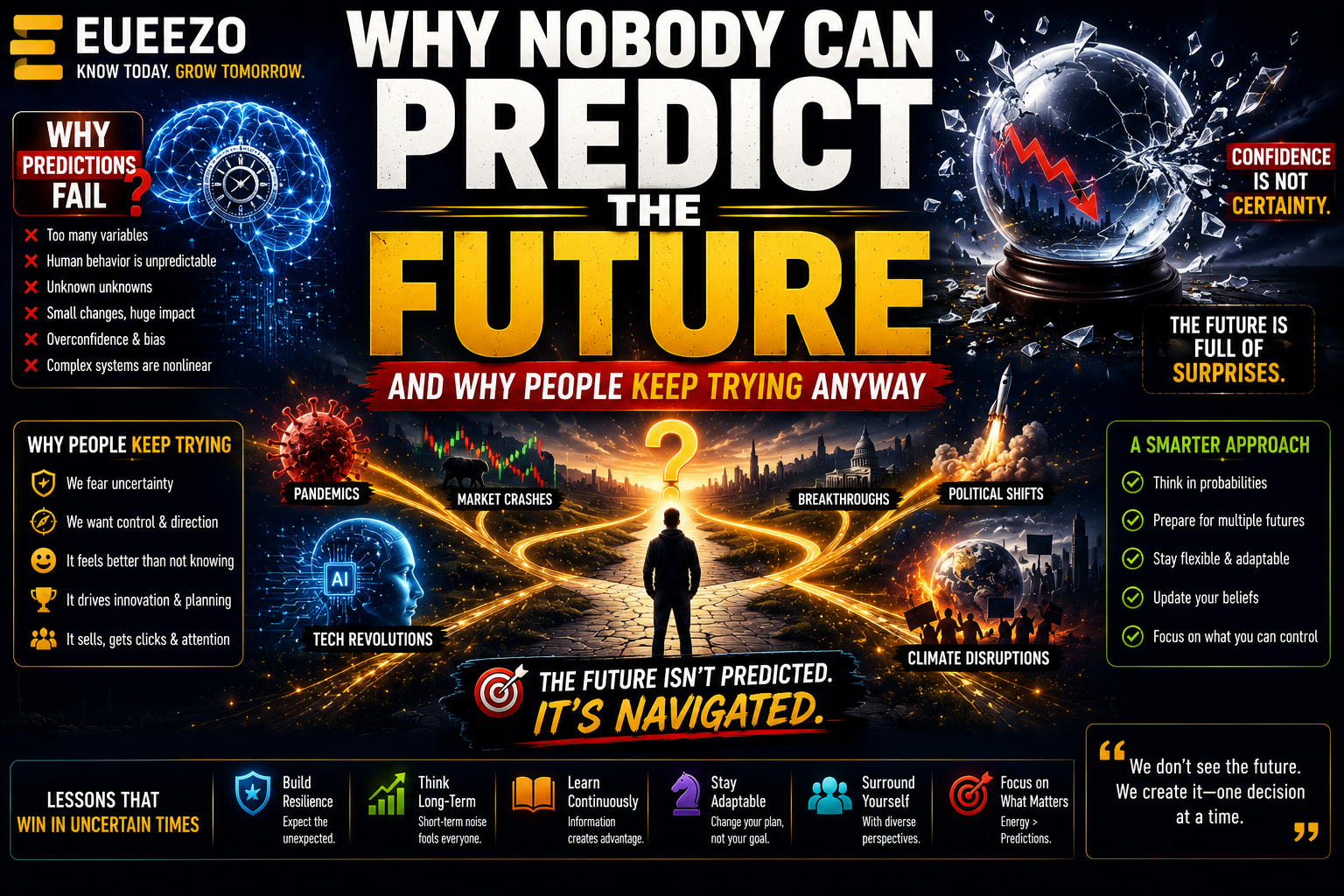
Why The Future Feels So Important
Humans spend enormous amounts of time thinking about the future.
Why?
Because prediction is deeply embedded in the brain.
Planning.
Goal setting.
Saving money.
Education.
Career development.
All involve future-oriented thinking.
The ability to imagine future possibilities helped humans build civilizations.
Prediction became a superpower.
When Predictions Go Wrong
Predictive brains are powerful.
They’re also imperfect.
Common mistakes include:
Overconfidence
Believing predictions are more accurate than they are.
Biases
Previous experiences distort expectations.
Fear-Based Predictions
Worst-case scenarios dominate thinking.
Confirmation Bias
People notice information supporting existing beliefs.
Understanding these tendencies improves decision-making.
Can You Improve Your Predictions?
Yes.
Several strategies help.
Seek Diverse Perspectives
Different viewpoints improve mental models.
Learn Continuously
Knowledge strengthens prediction accuracy.
Reflect on Mistakes
Errors provide valuable information.
Embrace Uncertainty
Not everything can be predicted.
The goal isn’t perfect forecasting.
It’s better forecasting.
The Future of Brain Research
Scientists continue exploring predictive processing.
Emerging research suggests prediction may influence:
- Perception
- Consciousness
- Memory
- Emotions
- Mental health
Some researchers even argue prediction is one of the brain’s most fundamental functions.
If true, it would reshape how we understand the human mind.
What This Means For Your Life
Understanding predictive brains changes how we interpret everyday experiences.
Why habits form.
Why surprises matter.
Why uncertainty feels uncomfortable.
Why learning requires mistakes.
Why expectations influence emotions.
The hidden system behind these experiences may be prediction itself.
And once you recognize it, you’ll start seeing evidence everywhere.
The Bottom Line
Your brain is not merely reacting to reality.
It’s constantly predicting reality.
Every second, it creates forecasts about what will happen next and updates those forecasts based on experience.
This predictive system influences:
- Decisions
- Emotions
- Habits
- Learning
- Relationships
It helps explain why humans seek certainty, why surprises capture attention, and why mistakes are essential for growth.
In many ways, the brain’s greatest achievement isn’t intelligence.
It’s anticipation.
Because long before the future arrives, your brain is already trying to meet it.