Month 2 Income Report: How I Nearly Doubled My Income (And What Actually Changed)
At the end of Month 1, I set myself a goal: ₹20,000.
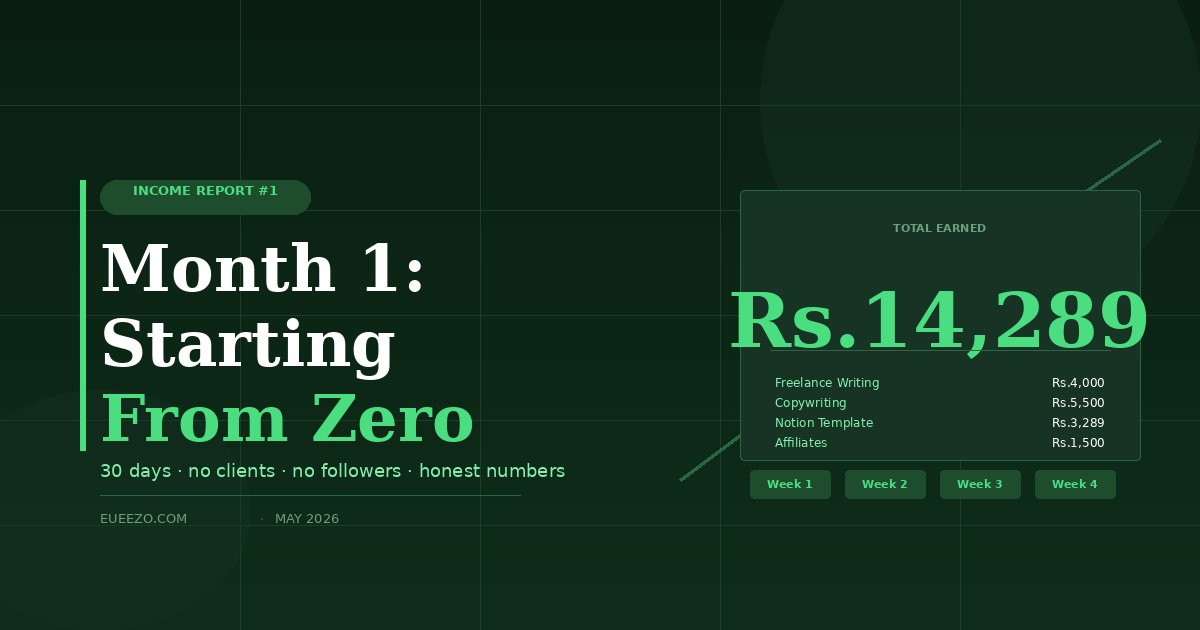
It felt ambitious. Month 1 had ended at ₹14,289 — a number I was genuinely proud of, but one that still felt fragile. Like a sandcastle. One bad week, one slow client, one quiet stretch on Gumroad and it could all wash away.
Month 2 ended at ₹26,400.
Not ₹20,000. ₹26,400. Nearly double Month 1. And the strangest part was that Month 2 felt easier than Month 1 in almost every way. Less grinding. Less uncertainty. Less of that low-level anxiety that had followed me through the first thirty days.
I spent a long time trying to understand why. What had actually changed between Month 1 and Month 2? Was it luck? Better skills? More hours worked?
It wasn’t any of those things.
It was compounding. And understanding how compounding actually works in a freelancing and digital income business is the most useful thing I can share with you today.
The Numbers First
Let me put the full breakdown on the table before anything else, because that’s the whole point of this series.
| Source | Month 1 | Month 2 | Change |
|---|---|---|---|
| Freelance Writing | ₹4,000 | ₹5,500 | +₹1,500 |
| Copywriting Projects | ₹5,500 | ₹7,200 | +₹1,700 |
| Notion Template Sales | ₹3,289 | ₹4,860 | +₹1,571 |
| Affiliate Commissions | ₹1,500 | ₹4,340 | +₹2,840 |
| New: Email Sequence Work | ₹0 | ₹4,500 | +₹4,500 |
| Total | ₹14,289 | ₹26,400 | +₹12,111 |
Three things stand out when I look at this table.
First: every single income stream grew. Not one of them shrank. This isn’t because I worked harder on each one — I didn’t. It’s because each stream had quietly been building momentum underneath the surface, and Month 2 was when that momentum started to show.
Second: the biggest jump was affiliate commissions — from ₹1,500 to ₹4,340. I’ll explain exactly why in a moment.
Third: the new income stream — email sequence writing — contributed ₹4,500 in its first month. That is a new skill I hadn’t been selling in Month 1. It came from one conversation with a client who asked if I could write email sequences. I said yes. I figured it out. I charged for it.
That ₹4,500 was entirely unplanned.
What Actually Changed: The Four Shifts
Shift 1: I Raised My Writing Rate
At the end of Month 1, I was charging ₹500 per article. My fellow freelancer had called this “about a third of what you should be charging.”
She was right.
In Week 1 of Month 2, I sent my existing agency client a simple message: my rate was moving to ₹800 per article from the following week. I explained nothing beyond that. I did not apologise. I did not offer a discount as a concession.
They replied within two hours: “That works, can we get three articles this week?”
That single message — twelve words long — added ₹900 to my monthly income from that client alone. The rate increase I had been afraid of for weeks took less than a minute to send and was accepted immediately.
If you are undercharging — and most freelancers are — a rate increase is the highest-return action you can take. The time investment is zero. The upside is immediate.
Shift 2: The Affiliate Flywheel Started Turning
In Month 1, I had one affiliate recommendation in one newsletter issue. Two people clicked it. Two people converted. ₹1,500.
In Month 2, I wrote three newsletter issues, each with one affiliate recommendation. I also went back to three old blog posts and added affiliate links where they were genuinely relevant — tools I had already mentioned without a link.
The result: eleven affiliate conversions across four different programmes. ₹4,340.
The mathematics here are important. My newsletter had grown from 47 to 112 subscribers between Month 1 and Month 2. That’s a 138% increase in audience. But my affiliate revenue grew by 189%. The revenue grew faster than the audience because I was getting better at placement and relevance — recommending the right things to the right people in the right context.
This is the flywheel. More content → more readers → more affiliate opportunities → more income. The wheel was turning slowly in Month 1. In Month 2 it was noticeably faster.
Shift 3: The Referral Network Activated
In Month 1, I got one referral — a client who mentioned my name to another business owner they knew.
In Month 2, I got three referrals.
I did not ask for referrals. I did not have a referral programme. I simply did good work for existing clients, delivered on time, communicated clearly, and was easy to work with.
Three referrals. Two converted to paying projects. One became my highest-paying client of the month — the email sequence project worth ₹4,500.
The lesson I keep relearning: the best marketing is doing good work. Every client you serve well is a potential source of future business. Treat them accordingly.
Shift 4: The Notion Template Got an Update
In Week 3 of Month 1, I had launched my Notion template and made 11 sales. In Month 2, I updated the template — added a new income projection dashboard and a client review tracker that several buyers had requested.
I sent one email to my 47 existing subscribers announcing the update. Four of them paid a small fee to upgrade. New buyers started mentioning the update in their reviews, which drove more organic discovery.
Month 2 template sales: 16 sales, average price ₹304. Total: ₹4,864.
One update. One email. ₹1,575 more than Month 1 from the same product.
This is the compounding power of digital products. The upfront work compounds. Each update, each review, each mention makes the product slightly more discoverable and slightly more trusted. The sales in Month 6 will partly be the result of work I did in Month 2.
What I Did More Of
Personalised pitching. In Month 1, I was still sending partially generic pitches. In Month 2, I committed fully to the specific, research-led approach — and my reply rate climbed from around 20% to 35%. Three pitches led to conversations. Two conversations led to projects.
Following up. Three clients I had pitched in Month 1 who hadn’t replied received a single gentle follow-up in Week 1 of Month 2. Two of them replied. One became a client.
Documenting as I went. I kept a daily log in Month 2 — nothing fancy, just a Notion page with date, what I worked on, what I earned, and one thing I noticed. This made writing this income report significantly easier and gave me data I didn’t have after Month 1.
What I Did Less Of
Spreading myself thin. In Month 1, I had profiles on five different freelancing platforms. In Month 2, I focused entirely on direct outreach and referrals. The platforms were generating almost no return for the time I spent on them. Cutting them freed up attention for things that were working.
Second-guessing my rates. I raised my rate once and it was accepted immediately. I stopped spending mental energy on whether my prices were too high. They weren’t. They probably still aren’t.
Treating every week in isolation. Month 1 felt like a series of disconnected efforts. Month 2 felt like a system. The difference was consistency — the same actions, repeated, starting to produce predictable results.
The Honest Challenges
Month 2 was not uniformly good. Two things went wrong.
A client paid late. A copywriting client who owed ₹3,600 for work delivered in Week 2 didn’t pay until the last day of the month — after two follow-up messages and a slightly uncomfortable direct phone call. The money eventually came. But the experience reminded me to start collecting a 50% deposit upfront on all new projects, which I implemented from Week 3 onwards.
I burned out mid-month. Around Day 18, I hit a wall. Writing six articles in a week while managing client communications, updating the template, and sending newsletter issues simultaneously was too much. I took two days completely off. The income didn’t collapse. The clients didn’t disappear. The world kept turning.
Rest is not a productivity failure. It’s a prerequisite for the kind of sustained output that Month 3 and beyond will require.
Goals for Month 3
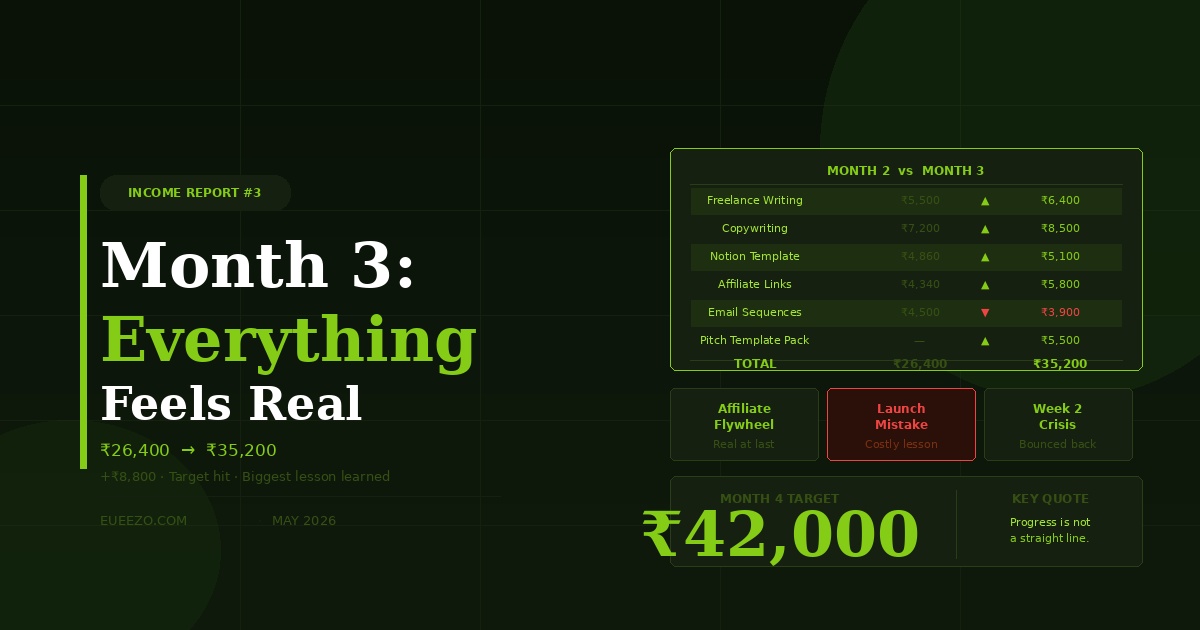
Income target: ₹35,000
Specific actions:
- Launch a second digital product — a freelance pitch template pack priced at ₹399
- Grow newsletter to 200 subscribers
- Raise copywriting rate to ₹3,500 per page
- Implement 50% upfront deposit for all new projects
- Write two SEO-targeted blog posts designed to rank for keywords with real search volume
The bigger picture goal: Month 3 is about systems. Month 1 was proving the concept. Month 2 was momentum. Month 3 needs to be the point where income becomes less dependent on my active time and more dependent on assets I’ve already built.
The newsletter, the templates, the affiliate links embedded in blog posts — these should be generating meaningful income without me needing to actively work on them every day. That’s the shift I’m working toward.
What This Means If You’re Just Starting
If you’re reading this from Month 0 — no income yet, wondering if any of this is real — here is what I want you to know.
Month 2 was better than Month 1 not because I suddenly became more talented or worked significantly more hours. It was better because Month 1 had happened. The clients from Month 1 referred new clients. The template from Month 1 had reviews that drove new sales. The newsletter subscribers from Month 1 were now clicking affiliate links.
Everything compounded. Everything built on itself.
You cannot skip to Month 2. You have to go through Month 1 first. The grinding, uncertain, low-revenue first month is not an obstacle to the good stuff — it is the foundation the good stuff is built on.
Do the work now. Trust that it compounds. Keep going.
Month 3 report drops in four weeks.
Subscribe to Eueezo below to get the Month 3 income report the moment it’s published — before it goes live on the blog.